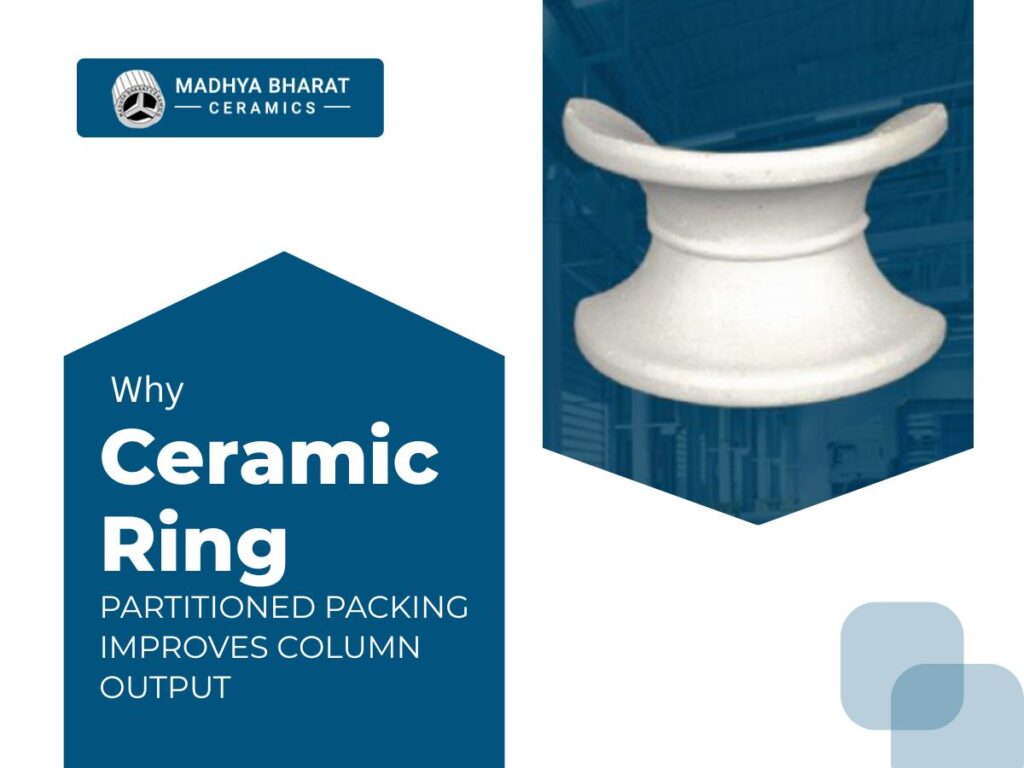
A major chemical facility in Gujarat producing specialty solvents faced persistent column capacity limitations preventing production increases to meet growing market demand. Their existing Raschig ring packing reached flooding conditions at 85% of designed capacity, causing quality issues and missed delivery commitments. In early 2024, the facility retrofitted three distillation columns with MBC’s ceramic ring partitioned packing. Results exceeded expectations: throughput increased by 32% without flooding, separation efficiency improved by 28%, pressure drop decreased by 25%, and energy consumption per unit product dropped by 18%. The facility now operates at 110% of original design capacity with superior product purity, demonstrating how advanced ceramic ring packing technology transforms column performance and profitability.
Process column efficiency directly impacts manufacturing costs, production capacity, product quality, and energy consumption across chemical, petrochemical, pharmaceutical, and environmental industries. Column packing selection represents one of the most critical design decisions affecting these performance parameters.
Ceramic ring partitioned packing has revolutionized mass transfer operations through innovative geometry that maximizes vapor-liquid contact while minimizing pressure drop. MBC, a leading ceramic ring manufacturer in India, produces advanced industrial ceramic rings with internal partitions that deliver measurable performance improvements over traditional packing designs.
Understanding Ceramic Ring Partitioned Design
Ceramic ring packing features a cylindrical shape with internal partitions or walls dividing the ring interior into multiple compartments or channels. This partitioned design fundamentally changes fluid dynamics within the packing bed, creating performance advantages that translate directly to improved column output.
Traditional non-partitioned rings allow liquid and vapor to flow through both the interior and exterior surfaces. While functional, this design permits preferential flow patterns and inadequate liquid distribution that reduce mass transfer efficiency.
Partitioned ring design innovations:
- Internal walls creating multiple flow channels
- Increased surface area without reducing void fraction
- Enhanced liquid spreading and film formation
- Reduced wall flow channeling effects
- Improved vapor distribution throughout the bed
- Optimized geometry for specific applications
The ceramic packing ring manufacturer MBC has refined partitioned ring designs through computational fluid dynamics analysis, pilot testing, and decades of industrial application experience. Our manufacturing precision ensures consistent geometry and performance across every production batch.
How Partitioned Design Increases Column Output
Understanding the mechanisms by which ceramic rings for mass transfer applications improve performance helps engineers optimize column designs and justify retrofit investments.
1. Enhanced liquid distribution:
The internal partitions in ceramic ring partitioned packing force liquid to spread across multiple surfaces rather than simply flowing through the ring center. This spreading action creates thinner, more uniform liquid films with higher surface area for vapor-liquid contact.
Improved liquid distribution means more effective utilization of available packing surface area. Every square meter of packing contributes to mass transfer rather than remaining dry or poorly wetted as occurs with simpler designs.
2. Reduced wall flow effects:
In packed columns, liquid tends to migrate toward the column wall creating zones of high liquid flow near walls and low flow in the column center. This maldistribution severely reduces separation efficiency.
Industrial ceramic rings with partitioned design disrupt these preferential flow patterns by redirecting liquid back toward the column center. The result is more uniform liquid distribution across the entire column diameter, ensuring consistent vapor-liquid contact throughout the packing bed.
3. Increased effective interfacial area:
The partitions increase total surface area available for liquid film formation by 30-45% compared to non-partitioned rings of equivalent size. This additional surface area directly increases the interfacial area where mass transfer occurs between vapor and liquid phases.
Higher interfacial area translates to increased mass transfer rates, enabling either higher column throughput at equivalent separation efficiency or improved separation at equivalent throughput. This flexibility allows operations to optimize for capacity, purity, or energy efficiency based on business priorities.
4. Improved vapor distribution:
The partitioned structure also influences vapor flow patterns, creating more turbulent mixing and reducing bypass flow where vapor travels through the packing without adequate liquid contact. Better vapor distribution means more effective utilization of the entire packing bed rather than concentration of separation duty in limited zones.
According to research published by the American Institute of Chemical Engineers, partitioned ring packings demonstrate 25-40% higher mass transfer coefficients compared to non-partitioned designs of equivalent size, directly enabling increased column output and efficiency.
Pressure Drop Advantages
While increasing surface area typically increases pressure drop, the intelligent design of ceramic rings used in distillation columns actually reduces pressure drop compared to other high-efficiency packings through optimized void fraction and flow geometry.
Pressure drop benefits:
- 20-35% lower pressure drop than equivalent structured packings
- 15-25% lower pressure drop than non-partitioned rings
- Higher void fraction (70-78%) reducing flow resistance
- Streamlined geometry minimizing turbulence losses
- Reduced energy consumption for column operation
Lower pressure drop provides multiple operational advantages. Reboiler duties decrease, reducing energy costs. Vacuum columns can achieve lower operating pressures, enabling separation of temperature-sensitive materials. Column capacity increases before reaching flooding limitations.
The chemical resistant ceramic rings manufactured by MBC optimize this balance between high surface area for mass transfer and adequate void space for low pressure drop, delivering superior performance across both parameters simultaneously.
Material Properties Supporting Performance
The performance advantages of ceramic ring partitioned packing extend beyond geometry to include superior material properties enabling reliable operation in demanding environments.
1. Chemical resistance:
Chemical resistant ceramic rings for towers resist attack from acids, alkalis, solvents, and virtually all industrial chemicals across the complete pH spectrum. This chemical inertness ensures consistent performance without degradation, contamination, or corrosion-related failures that plague metallic packings.
The ceramic ring manufacturer MBC produces rings from high-purity alumina and industrial-grade porcelain, both offering exceptional chemical resistance. Material selection depends on specific application requirements balancing performance needs with economic considerations.
2. Thermal stability:
Tower packing ceramics maintain structural integrity and dimensional stability at temperatures from cryogenic to 1,400°C depending on material composition. This extreme temperature capability enables applications impossible with plastic or metallic packings.
High-temperature distillation, thermal cracking operations, and other processes requiring elevated temperatures benefit from ceramic packing’s thermal performance. The material neither degrades, deforms, nor loses mechanical properties across wide temperature ranges.
3. Mechanical durability:
The partition design might suggest fragility, but properly manufactured industrial ceramic packing demonstrates excellent mechanical strength. The partitions actually increase overall ring strength by providing internal support structure preventing collapse under load.
MBC’s manufacturing processes create dense, fully sintered ceramic bodies with mechanical properties ensuring reliable service in industrial columns. Proper handling during installation and operation provides decades of maintenance-free performance.
Critical Industrial Applications
Ceramic rings for chemical and petrochemical plants serve essential functions across diverse industries requiring high-efficiency separation with exceptional reliability.
1. Chemical Manufacturing and Processing
The chemical industry employs ceramic ring partitioned packing in numerous critical separation processes where efficiency, purity, and reliability directly impact profitability.
Applications include:
- Distillation columns separating product mixtures
- Absorption towers removing impurities from gas streams
- Stripping columns recovering valuable solvents
- Extraction columns for liquid-liquid separations
- Reactive distillation combining reaction and separation
- Cryogenic separations at extremely low temperatures
The combination of high efficiency and chemical resistance makes industrial ceramic rings indispensable for these demanding applications. Product purity requirements often mandate ceramic packing to eliminate any risk of metallic contamination.
2. Petrochemical and Refining Operations
Refineries and petrochemical plants operate some of the largest, most demanding separation processes in industry. Ceramic rings used in distillation columns at these facilities must deliver maximum efficiency while withstanding corrosive hydrocarbons, sulfur compounds, and acidic conditions.
Refining applications:
- Crude distillation atmospheric towers
- Vacuum distillation columns
- Catalytic cracker fractionators
- Alkylation unit separations
- Amine treating systems
- Sulfur recovery units
The ceramic ring supplier MBC works closely with refinery engineers to specify optimal packing for these critical services, ensuring maximum throughput, energy efficiency, and reliability.
3. Pharmaceutical and Fine Chemical Production
Pharmaceutical manufacturing demands absolute purity and zero contamination from process equipment. Chemical resistant ceramic rings meet stringent regulatory requirements while delivering the high separation efficiency necessary for producing complex molecules.
The ceramic ring manufacturer in India MBC supplies pharmaceutical-grade packing with complete documentation, material certifications, and batch traceability supporting regulatory compliance and validation requirements.
4. Environmental Control Systems
Mass transfer ceramic rings play crucial roles in pollution control systems protecting air and water quality by removing harmful contaminants before environmental release.
Environmental applications:
- Acid gas scrubbers in power generation
- VOC recovery systems in chemical facilities
- Odor control in wastewater treatment
- Scrubbing systems for industrial emissions
- Carbon capture and storage systems
The durability and chemical resistance of tower packing ceramics ensures reliable long-term performance in these critical environmental protection applications where failures can result in regulatory violations and environmental damage.
Performance Comparison with Alternative Packings
Evaluating ceramic ring partitioned packing against other packing types reveals significant performance and economic advantages justifying its selection for high-value applications.
Advantages over non-partitioned rings:
- 25-40% higher mass transfer efficiency
- 15-25% lower pressure drop
- Better liquid distribution characteristics
- Higher capacity before flooding
- Improved turndown performance
Benefits compared to saddles and other random packings:
- More predictable performance characteristics
- Easier installation with less segregation risk
- Better mechanical strength and durability
- Higher packing density for given void fraction
- More consistent performance across column diameter
Advantages versus structured packing:
- Significantly lower initial cost
- Simpler installation without special equipment
- Better fouling resistance with easier cleaning
- Excellent performance across wide operating ranges
- Lower risk of mechanical damage during operation
Size Selection and Column Design Optimization
Optimizing column performance requires selecting appropriate ceramic ring packing sizes based on column diameter, operating conditions, and performance priorities.
Available sizes:
MBC manufactures industrial ceramic rings in standard sizes including 15mm, 25mm, 38mm, and 50mm outside diameters. Smaller rings provide maximum surface area and efficiency, while larger rings offer higher capacity with lower pressure drop.
Selection guidelines:
- Small columns (under 500mm): 15-25mm rings
- Medium columns (500-1500mm): 25-38mm rings
- Large columns (over 1500mm): 38-50mm rings
- High-purity critical separations: smaller sizes
- High-capacity operations: larger sizes
The ceramic ring exporter MBC provides comprehensive engineering support including column modeling, performance prediction, and optimization studies ensuring customers achieve maximum return on their packing investment.
Installation and Operational Best Practices
Proper installation and operation of ceramic rings for mass transfer applications maximizes performance and ensures long service life.
Installation recommendations:
- Clean column internals thoroughly before installation
- Inspect rings for damage and remove broken pieces
- Use controlled dumping techniques preventing segregation
- Achieve uniform packing density throughout the bed
- Install adequate support grids with proper free area
- Provide effective liquid distribution above the packing
Operational guidelines:
Maintain process parameters within design specifications. Monitor key performance indicators including pressure drop, product purity, and throughput. Implement regular inspection schedules. Follow proper startup and shutdown procedures preventing thermal shock.
The ceramic packing ring manufacturer MBC provides detailed installation manuals, training support, and troubleshooting assistance ensuring customers achieve optimal column performance from their ceramic packing investment.
Quality Manufacturing and Global Supply Capability
MBC’s reputation as a premier ceramic ring manufacturer in India reflects our commitment to manufacturing excellence, quality consistency, and customer service.
Quality control measures:
- Raw material testing verifying composition and purity
- Dimensional inspection ensuring geometry accuracy
- Partition integrity testing confirming structural soundness
- Surface quality evaluation optimizing performance
- Mechanical strength testing verifying durability
- Batch documentation providing complete traceability
As an established ceramic ring exporter, MBC serves customers worldwide with comprehensive logistics capabilities ensuring timely delivery regardless of location. Our global supply network combines manufacturing expertise with efficient distribution and responsive customer support.
Economic Value Through Enhanced Performance
While ceramic ring partitioned packing represents a significant capital investment, the economic value delivered through improved performance typically provides payback periods of 6-24 months depending on application.
Economic benefits include:
- Increased throughput generating additional revenue
- Improved separation reducing energy consumption
- Higher product purity commanding premium prices
- Extended service life reducing replacement frequency
- Reduced maintenance requirements lowering costs
- Avoided production losses from unplanned shutdowns
According to the International Organization for Standardization guidelines on lifecycle cost analysis, properly selected high-performance packing delivers superior total cost of ownership through the combination of operational improvements and extended service life.
Technical Support and Engineering Services
Beyond manufacturing superior tower packing ceramics, MBC provides comprehensive technical support helping customers optimize column performance and solve processing challenges.
Engineering services include:
- Column packing selection and sizing analysis
- Performance modeling and prediction
- Retrofit studies and recommendations
- Installation supervision and commissioning
- Performance testing and optimization
- Troubleshooting and problem resolution
This technical support ensures customers achieve maximum value from their ceramic rings for chemical and petrochemical plants investment through optimized design, proper installation, and efficient operation.
FAQ’s About Ceramic Ring
1. How much does ceramic ring packing improve column output?
Ceramic ring partitioned packing typically increases column output by 25-40% compared to traditional packings through higher mass transfer efficiency, lower pressure drop, and better liquid distribution enabling higher throughput before reaching flooding limitations.
2. What makes partitioned rings more efficient than non-partitioned designs?
Internal partitions increase surface area by 30-45%, improve liquid distribution, reduce wall flow effects, and enhance vapor-liquid contact. These geometric advantages translate directly to 25-40% higher mass transfer coefficients and measurably improved separation performance.
3. Are ceramic rings suitable for corrosive chemicals?
Yes, chemical resistant ceramic rings for towers resist virtually all industrial chemicals including strong acids, caustic alkalis, organic solvents, and oxidizing agents across the complete pH spectrum at any concentration and elevated temperatures without degradation.
4. How long do ceramic ring packings last?
Industrial ceramic rings typically provide 7-15 years of service in most applications, with potentially unlimited life in non-fouling, non-abrasive services. Actual service life depends on operating conditions, chemical environment, and maintenance practices.
5. What size ceramic rings should I use?
Size selection depends on column diameter and performance priorities. Smaller rings (15-25mm) provide maximum efficiency for critical separations. Larger rings (38-50mm) offer higher capacity with lower pressure drop for high-throughput applications. Consult manufacturers for recommendations.
6. Can ceramic ring packing handle high temperatures?
Yes, tower packing ceramics maintain structural integrity and performance at temperatures up to 1,400°C depending on material composition. This exceptional thermal stability enables high-temperature distillation and thermal processing applications impossible with alternative materials.
7. How does ceramic ring packing reduce energy consumption?
Lower pressure drop reduces reboiler duty and compression requirements. Higher mass transfer efficiency enables operation with fewer theoretical stages. Improved separation reduces recycle streams. These factors combine to reduce energy consumption by 15-30% in typical applications.
8. Is ceramic ring packing worth the higher initial cost?
Yes, ceramic rings for mass transfer applications deliver superior lifecycle economics through increased output, improved efficiency, reduced energy costs, and extended service life. Typical payback periods range from 6-24 months with ongoing operational savings thereafter.
Conclusion
Ceramic ring partitioned packing represents a proven technology for improving column output, efficiency, and reliability in demanding industrial applications. The innovative internal partition design delivers measurable performance advantages through enhanced liquid distribution, increased effective surface area, and optimized fluid dynamics.
MBC’s position as a leading ceramic ring manufacturer in India reflects decades of manufacturing excellence, continuous innovation, and unwavering commitment to customer success. Our precision-manufactured industrial ceramic rings combine optimal geometry with superior material properties, ensuring maximum performance in your specific application.