When a major refinery in Rajasthan needed column packing that could withstand continuous sulfuric acid exposure at operating temperatures above 300 degrees Celsius without replacement for five or more years, the engineering team specified high-alumina ceramic materials from a certified ceramic materials manufacturer in India. This single procurement decision eliminated a recurring maintenance cycle that had previously required column shutdown every 14 months. According to the Global Ceramic Federation, the industrial ceramics market serving chemical and petrochemical applications exceeded 12 billion US dollars in 2024, driven by escalating process temperatures, stricter environmental regulations, and the growing demand for corrosion-resistant materials in aggressive chemical environments. Understanding the role of ceramic materials in chemical processing plants is essential for every process engineer, plant manager, and procurement specialist working in these industries.
What Makes Ceramic Materials Essential in Chemical Industries?
The chemical and petrochemical industries operate in conditions that rapidly degrade most conventional engineering materials. Elevated temperatures, concentrated mineral acids, oxidizing atmospheres, and continuous mechanical stress combine to create environments where metals corrode, polymers degrade, and composite materials fail prematurely.
Ceramic materials survive where other materials cannot because their fundamental chemistry is different. Ceramics are formed from ionic and covalent bonds between metal and non-metal atoms. These bonds are inherently more resistant to chemical attack, thermal degradation, and oxidative breakdown than the metallic bonds in steel or the carbon-chain structures in polymers.
The four material properties that make industrial ceramics applications indispensable in chemical processing are:
- Chemical inertness across wide pH ranges and oxidation states
- Thermal stability from cryogenic temperatures to above 1600 degrees Celsius
- Mechanical strength retention at elevated temperatures where metals soften
- Dimensional stability across repeated thermal cycles without creep or distortion
Role of Ceramic Materials in Chemical Processing Plants
The role of ceramic materials in chemical processing plants covers every stage of the chemical production process, from raw material preparation through reaction, separation, and product purification.
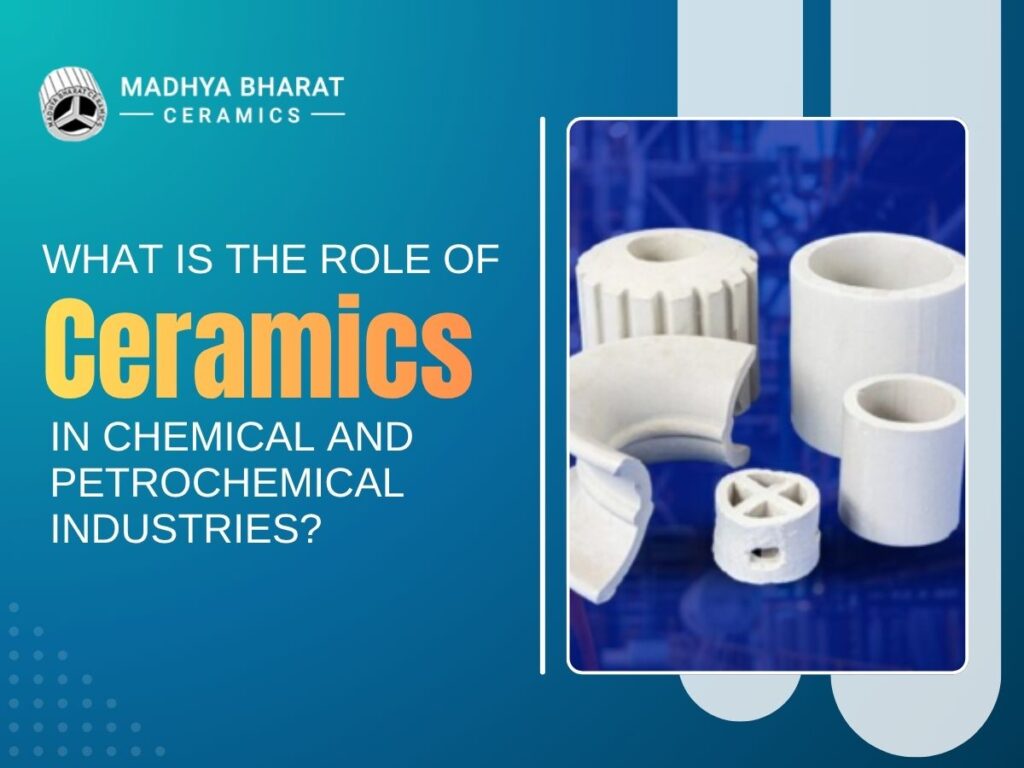
Tower packing and column internals represent the largest volume application of ceramics in chemical plants. Distillation columns, absorption towers, stripping columns, and scrubbing systems all use ceramic packing rings, saddles, and structured packings to provide mass transfer surface area between gas and liquid phases.
Why ceramic tower packing is preferred in chemical plants:
- Ceramic packing resists all mineral acids including sulfuric, hydrochloric, nitric, and phosphoric acid at all concentrations
- Ceramic packing operates continuously at temperatures that would melt plastic packing and corrode metal packing
- Ceramic packing does not contaminate process streams through leaching, dissolution, or surface reaction
- Ceramic packing maintains its geometric shape and void fraction throughout its service life, keeping mass transfer efficiency stable
Applications of ceramic packing in chemical industries:
- Sulfuric acid absorption towers requiring acid-resistant packing at high temperatures
- Hydrochloric acid scrubbers where both acid resistance and thermal stability are required
- Nitric acid absorption columns operating under combined acid and nitrogen oxide exposure
- Solvent recovery columns requiring chemically inert packing that does not react with organic compounds
- Chlor-alkali production where simultaneous chlorine and alkali resistance is required
Why Ceramics Are Used in Petrochemical Industries
Why ceramics are used in petrochemical industries is a question answered by three converging process demands: high temperature, hydrocarbon chemical exposure, and catalytic function requirements.
Petroleum refining involves processing crude oil streams at temperatures ranging from 200 degrees Celsius in atmospheric distillation to over 800 degrees Celsius in catalytic cracking and reforming units. These temperatures exceed the operating range of most polymers and many metals, but fall well within the stable operating range of high temperature resistance ceramics.
Primary applications of ceramics in petrochemical processing:
Catalyst support beds: Inert ceramic balls, rings, and structured supports provide stable beds for heterogeneous catalysts in fixed-bed reactors. Catalyst support materials in ceramic form provide precise surface area, controlled void fraction, and chemical neutrality that ensures catalyst performance is not compromised by support material interactions.
Reactor linings and refractory components: High-temperature reactors, reformers, and cracking furnaces use ceramic refractory linings to contain process temperatures and protect structural steel from thermal and chemical attack.
Heat exchanger media: Ceramic honeycomb and sphere packing in regenerative heat exchangers store and release thermal energy in cyclic heating and cooling systems, achieving heat recovery efficiencies above 95%.
Fired heater components: Radiant tubes, burner tiles, and combustion chamber linings in process heaters use ceramic materials for combined thermal resistance and oxidation stability.
Benefits of Using Industrial Ceramics in Harsh Environments
Benefits of using industrial ceramics in harsh environments extend beyond simple corrosion resistance. The complete performance profile of ceramic materials in demanding process environments includes properties that collectively justify their specification over competing materials.
Comprehensive benefits of industrial ceramics in chemical and petrochemical applications:
| Property | Ceramic Performance | Metal Alternative | Polymer Alternative |
| Acid resistance | Excellent across all concentrations | Poor to moderate | Good to excellent |
| Alkali resistance | Good to excellent | Poor | Excellent |
| Maximum operating temperature | 800 to 1600 degrees C | 400 to 800 degrees C | 80 to 200 degrees C |
| Oxidation resistance | Excellent | Poor to moderate | Poor |
| Compressive strength | 60 to 150 MPa | 30 to 200 MPa | 5 to 20 MPa |
| Creep at elevated temperature | None | Significant | Significant |
| Chemical contamination risk | None | Moderate (corrosion products) | Low to moderate |
| Service life in acid service | 10 to 20 years | 2 to 5 years | 3 to 7 years |
| Dimensional stability | Excellent | Moderate | Poor |
The service life data in this table represents the most significant economic advantage of ceramic materials in chemical plant applications. A ceramic packing installation that lasts 15 years versus a metal alternative requiring replacement every 3 years delivers five replacement cycles of avoided downtime, labour, and material cost across the same operational period.
Importance of Corrosion Resistant Ceramics in Refineries
The importance of corrosion resistant ceramics in refineries is understood most clearly by examining what happens when the wrong material is specified. Corrosion failures in refinery equipment are among the most costly and dangerous events in process industry operations.
Crude oil contains sulfur compounds, chlorides, naphthenic acids, and water that create a complex corrosive mixture at processing temperatures. Refinery overhead systems, where hydrochloric acid condenses from crude oil chloride content, represent one of the most aggressive corrosion environments in any process industry.
Ceramic materials in refinery applications address corrosion risk in several critical service areas:
- Overhead condenser internals: Ceramic saddle packing in refinery overhead systems resists the combined attack of hydrochloric acid and water condensate that rapidly corrodes carbon and alloy steel
- Desulfurization unit columns: Ceramic packing in amine absorption and regeneration columns resists the combined thermal and chemical stress of H2S removal service
- Alkylation unit internals: Ceramic components in hydrofluoric and sulfuric acid alkylation units provide acid-resistant surfaces in direct contact with concentrated acid catalysts
- Sour water stripper columns: Ceramic packing resists the combined ammonia, hydrogen sulfide, and water environment of sour water treatment systems
Thermal insulation ceramics in refinery pipe insulation, vessel insulation, and fired heater systems reduce surface temperatures, protect personnel, minimize heat loss, and extend equipment life by reducing thermal cycling stress on pressure-containing components.
What Is the Role of Ceramics in Transforming Industries?
What is the role of ceramics in transforming industries? extends well beyond traditional chemical and petrochemical applications. Advanced ceramic materials are driving transformation across multiple industrial sectors through properties that no other material class can replicate.
Industries being transformed by advanced ceramic materials:
Environmental technology: Ceramic diesel particulate filters, SCR catalyst substrates, and regenerative thermal oxidizer media are central components of industrial and automotive emission control systems that enable compliance with tightening global environmental standards.
Energy production: Solid oxide fuel cells use ceramic electrolyte and electrode materials to convert hydrogen and hydrocarbon fuels directly to electricity at high efficiency. Ceramic thermal barrier coatings in gas turbine hot section components allow turbine inlet temperatures 200 to 300 degrees Celsius above the melting point of the underlying metal alloy.
Water treatment: Ceramic membrane filtration systems provide nanofiltration, ultrafiltration, and microfiltration capability in water treatment and industrial process liquid separation applications. Ceramic membranes outperform polymer membranes in high-temperature, high-pH, and oxidizing chemical cleaning environments.
Electronics and semiconductors: Alumina and silicon carbide ceramic substrates provide the electrical insulation, thermal management, and dimensional stability required by advanced electronic packaging in power electronics, telecommunications, and computing applications.
Ceramic Materials Manufacturers in India: Supply Capability and Quality Standards
Ceramic materials manufacturers in India have developed into globally competitive suppliers over the past three decades, driven by domestic industrial growth, raw material availability, and increasing adoption of international quality standards.
India’s position as a major supplier of industrial ceramic materials rests on several structural advantages:
- Abundant domestic deposits of key raw materials including bauxite, china clay, silica, and magnesite
- Established manufacturing clusters in Madhya Pradesh, Gujarat, Rajasthan, and Andhra Pradesh with decades of production expertise
- Growing adoption of ISO 9001, ISO 14001, and product-specific international certifications
- Competitive manufacturing costs that support supply to international markets at attractive price points
- Strong engineering capability to develop application-specific ceramic formulations for demanding process conditions
Ceramic materials in Mandsaur, Madhya Pradesh represents a specific geographic concentration of ceramic manufacturing expertise. MBC, based in Mandsaur, supplies ceramic materials to chemical plants, petrochemical refineries, fertilizer manufacturers, and environmental engineering contractors across India and internationally as a certified ceramic materials exporter.
Case Study
A urea fertilizer manufacturer in Madhya Pradesh was experiencing accelerating corrosion failure in their CO2 absorption column packing. The original installation used stainless steel Pall rings in the lower, high-temperature section of the column operating at 180 degrees Celsius with 30% potassium carbonate solution.
Problem: Corrosion pitting on the stainless steel rings was generating iron contamination in the process stream, fouling downstream catalyst beds and requiring column inspection and packing replacement every 22 months. Each replacement required a 10-day column shutdown.
Solution: In consultation with MBC as their ceramic materials supplier, the engineering team replaced the lower column section packing with high-alumina ceramic Pall rings, specifying 90% alumina content for combined thermal and chemical resistance in the potassium carbonate service.
Performance comparison over 36 months post-installation:
| Parameter | Stainless Steel Pall Rings | Ceramic Pall Rings (90% Alumina) |
| Corrosion observed | Significant pitting at 22 months | No corrosion detected at 36 months |
| Iron contamination in process stream | 15 to 25 ppm | Below detection limit |
| Catalyst bed fouling frequency | Every 22 months | No fouling detected |
| Column shutdown for packing replacement | Every 22 months | No replacement required at 36 months |
| Pressure drop stability | Declining due to pitting and settling | Stable within 2% of design |
| Total maintenance cost over 36 months | High, two replacement cycles | Significantly reduced, zero replacements |
Plant chief engineer’s assessment: “The switch to ceramic packing eliminated the iron contamination problem completely. The catalyst beds have been clean for three years. The payback on the ceramic upgrade was under 12 months when we factored in avoided downtime and catalyst replacement costs.”
FAQ’s Ceramics in Chemical and Petrochemical Industries
Q1. What is the role of ceramic materials in chemical processing plants?
Ceramics serve as tower packing, catalyst supports, reactor linings, and heat exchange media in chemical processing applications.
Q2. Why are ceramics used in petrochemical industries specifically?
Ceramics withstand petrochemical process temperatures, resist hydrocarbon chemical attack, and provide stable catalyst support bed performance.
Q3. What are the benefits of using industrial ceramics in harsh environments?
Ceramics provide 10 to 20 year service life, zero contamination risk, and stable performance in acid, alkali, and high-temperature environments.
Q4. How do corrosion resistant ceramics improve refinery operations?
Ceramic materials eliminate metal corrosion failures in acid-contact services, reducing shutdown frequency and process contamination incidents significantly.
Q5. What types of ceramic packing are used in chemical industry columns?
Raschig rings, Pall rings, saddle packing, and structured ceramic honeycomb are the most common column packing types in chemical plants.
Q6. What temperature can industrial ceramic materials withstand in process service?
Standard industrial ceramics operate continuously to 800 degrees Celsius. High-alumina ceramics withstand continuous service above 1400 degrees Celsius.
Q7. Are ceramic materials manufacturers in India internationally certified?
Leading Indian manufacturers hold ISO 9001 certification and supply products meeting ASTM, DIN, and international ceramic material specifications.
Q8. How do ceramic catalyst supports improve chemical reaction performance?
Ceramic catalyst supports provide stable, high-surface-area, chemically neutral substrates that maximize catalyst activity and extend catalyst service life.
Conclusion
Ceramic materials are not simply an alternative to metals and polymers in chemical and petrochemical industries. They are the only materials that reliably combine corrosion resistance, thermal stability, mechanical strength, and chemical inertness across the full range of conditions that these industries impose. From sulfuric acid absorption towers to catalytic reactor beds and refinery overhead systems, ceramic materials protect plant integrity, extend equipment life, and reduce operational costs in ways that no other material class can replicate. Choosing a certified ceramic materials manufacturer in India with documented engineering capability, quality management systems, and application-specific product development expertise is the foundation of every successful industrial ceramics installation.