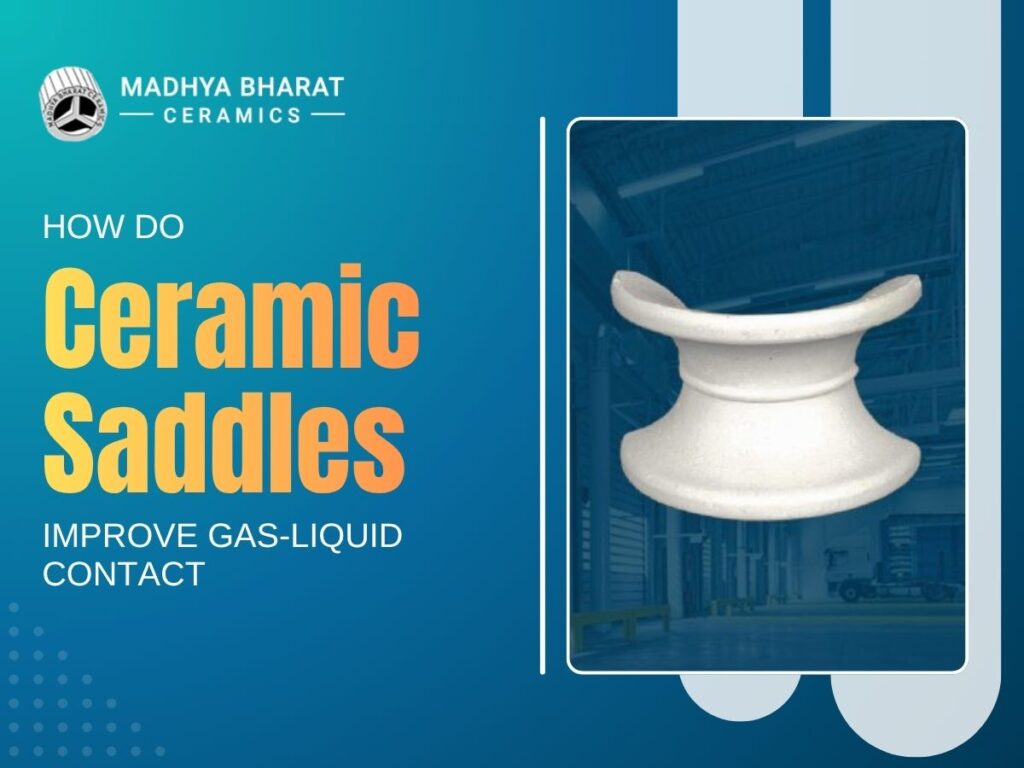
Ceramic saddles are one of the most widely used types of tower packing materials in the chemical processing industry. According to published chemical engineering data, saddle-shaped packing can improve mass transfer efficiency by up to 30% compared to basic cylindrical packing like Raschig rings. This makes them a preferred choice for engineers designing distillation column packing and absorption systems.
Ceramic saddles in India are in high demand across pharma, petrochemical, sulphuric acid, and fertiliser plants. India operates over 1,200 registered chemical manufacturing units that rely on packed towers for chemical absorption processes and gas purification. The need for reliable, high-performance gas-liquid contact media has made ceramic saddles a standard specification across these sectors.
A sulphuric acid plant in Gujarat recently replaced its old cylindrical ceramic packing with ceramic saddle tower packing from MBC. Within one operating cycle, the plant reported a 22% improvement in acid absorption efficiency and a measurable reduction in pressure drop across the absorption tower. This real-world result shows why ceramic saddles in India continue to replace older packing types across demanding industrial applications.
What Are Ceramic Saddles? Understanding Tower Packing Materials
Ceramic saddles are curved, saddle-shaped pieces of fired ceramic used as random packing inside industrial towers, columns, and scrubbers. Their distinctive curved geometry is the key to their performance. Unlike flat or cylindrical packing, the saddle shape allows pieces to nest in multiple orientations without stacking directly on top of each other.
This random orientation creates a highly irregular flow path for both gas and liquid. Gas and liquid are forced to change direction repeatedly as they pass through the bed. Each direction change brings gas and liquid into contact, which drives the chemical absorption process and improves mass transfer efficiency throughout the column.
There are two main types of ceramic saddles used in industrial towers:
- Berl Saddles: The original saddle design, with a simple curved shape and smooth edges. These are widely used in older installations and remain effective for many applications.
- Intalox Saddles: An improved design with modified curves that reduce nesting and improve liquid distribution. Intalox ceramic saddles offer better performance in modern high-capacity towers.
MBC supplies both types as part of its ceramic saddles tower packing product range.
How Ceramic Saddles Improve Gas-Liquid Contact in Packed Towers
The core function of ceramic saddles is to maximise the surface area available for gas-liquid interaction inside a packed tower. When liquid flows down over the curved surfaces and gas rises through the spaces between rings, the irregular saddle geometry spreads the liquid into thin films. These thin films expose a large liquid surface to the rising gas stream.
Here is a step-by-step explanation of how ceramic saddles improve gas-liquid contact in industrial towers:
- Surface Film Formation: Liquid coats the curved ceramic surface as it flows downward, forming a thin film with a very large exposed area.
- Turbulent Gas Flow: Rising gas hits the irregular saddle surfaces and is repeatedly redirected, keeping the gas in constant contact with fresh liquid film.
- Pressure Drop Reduction: The saddle shape minimises gas channelling and creates an even flow distribution, which reduces pressure drop reduction across the bed.
- Liquid Redistribution: Each saddle piece redirects liquid sideways and downward, preventing liquid from flowing straight down in narrow channels (a problem called channelling).
- Absorption and Transfer: Absorbed components move from the gas phase into the liquid film across the large surface area created by the ceramic saddle tower packing bed.
This combination of thin-film coverage, turbulent contact, and uniform distribution is why ceramic saddles in India are specified for demanding gas absorption and distillation duties.
Ceramic Saddles vs Other Tower Packing Materials: Comparison Table
The table below compares ceramic saddles against other common tower packing materials used in industrial columns:
| Feature | Ceramic Saddles | Raschig Rings | Pall Rings (PP) | Structured Packing |
| Material | Fired Ceramic | Ceramic or Metal | Polypropylene | Metal or Plastic |
| Shape | Curved Saddle | Hollow Cylinder | Open Ring | Corrugated Sheet |
| Pressure Drop | Low | High | Very Low | Very Low |
| Mass Transfer | High | Moderate | High | Very High |
| Temperature Resistance | Excellent (up to 1200 C) | Good | Limited (80 C) | Moderate |
| Corrosion Resistance | Excellent | Moderate | Good | Moderate |
| Cost | Moderate | Low | Low | High |
| Best Application | Acid and Gas Absorption | General Use | Gas Scrubbing | High Purity Distillation |
As the table shows, ceramic saddles offer the best balance of temperature resistance, corrosion resistance, and mass transfer efficiency for chemical and acid processing applications. PP Pall Rings are suitable for lower-temperature scrubbing, while structured packing suits high-purity distillation at premium cost.
Key Benefits of Ceramic Saddles for Chemical Tower Packing Systems
Ceramic saddle tower packing delivers a range of practical advantages that explain its long-standing use in Indian and global chemical plants. These benefits are directly linked to the physical and chemical properties of fired ceramic material and the saddle geometry.
- High Surface Area Enhancement: The saddle shape creates more usable surface per unit volume than cylindrical packing, directly improving mass transfer efficiency.
- Thermal Stability: Ceramic withstands operating temperatures up to 1,200 degrees Celsius. This makes it suitable for hot gas absorption duties where plastic packing would fail.
- Chemical Inertness: Ceramic does not react with sulphuric acid, hydrochloric acid, nitric acid, or most industrial solvents. This makes it the best choice for corrosive chemical absorption processes.
- Mechanical Strength: High-quality fired ceramic resists crushing under the weight of deep packing beds, maintaining bed integrity over long operating cycles.
- Consistent Performance: Unlike metal packing that can corrode or plastic packing that can deform, ceramic maintains its shape and surface properties over many years of operation.
- Low Maintenance: Once installed, ceramic saddles require minimal attention. There are no moving parts, and bed replacement is only needed when physical breakage is detected.
Where Are Ceramic Saddles in India Used? Industry Applications
Ceramic saddles in India serve a wide range of industries. As a dedicated ceramic saddles manufacturer and ceramic saddles supplier, MBC has supplied ceramic tower packing to plants operating across the following sectors:
- Sulphuric Acid Plants: Absorption towers in sulphuric acid production use ceramic saddle tower packing to absorb SO3 from gas streams. Ceramic is the only practical packing material at these temperatures and acid concentrations.
- Hydrochloric Acid Plants: HCl absorption columns use ceramic saddles because the material resists attack from both gaseous HCl and aqueous hydrochloric acid solutions.
- Fertiliser Industry: Nitric acid absorption towers and ammonia scrubbers in fertiliser plants rely on industrial mass transfer packing in ceramic form for reliable performance.
- Petrochemical Industry: Distillation columns and stripper units in refineries use ceramic saddles for high-temperature separation duties.
- Pharmaceutical Industry: Solvent recovery columns and acid neutralisation scrubbers use ceramic saddle tower packing where chemical purity and inertness are critical.
- Chlor-Alkali Plants: Chlorine drying towers and HCl synthesis units use ceramic saddles in India as the standard packing material.
Why Choose MBC as Your Ceramic Saddles Manufacturer and Exporter in Mandsaur
MBC is an established ceramic saddles manufacturer in Mandsaur with a strong track record of supplying high-quality ceramic saddle tower packing to industrial clients across India and international markets. MBC products are produced using high-grade ceramic raw materials and fired at controlled temperatures to ensure consistent density, hardness, and chemical resistance.
MBC is the right choice for your ceramic saddles needs because of the following:
- Verified Manufacturing Quality: All MBC ceramic saddles pass dimensional and strength checks before dispatch.
- Full Size Range: MBC supplies ceramic saddles in sizes from 13 mm to 76 mm to suit all tower diameters and process duties.
- Reliable Supply: MBC maintains ready stock for fast dispatch to clients across India, minimising plant downtime during packing replacement.
- Export Capability: As a certified ceramic saddles exporter, MBC ships to international clients with full documentation support.
- Technical Guidance: MBC engineers assist clients with packing selection, sizing, and installation recommendations for specific distillation column packing and absorption duties.
- Competitive Pricing: MBC offers transparent bulk pricing for large orders from ceramic saddles suppliers in India.
Case Study
Client: A sulphuric acid manufacturing plant in Gujarat, India.
Challenge: The plant was using old Raschig ring packing in its first-pass SO3 absorption tower. The packing bed was showing high pressure drop, uneven liquid distribution, and absorption efficiency below the design specification. The plant needed a solution that could handle continuous exposure to concentrated sulphuric acid at elevated temperatures.
Solution: MBC recommended replacing the Raschig rings with 50 mm ceramic Intalox saddles from its standard ceramic saddle tower packing range. The tower was repacked during a scheduled maintenance shutdown using the same tower shell dimensions. No structural modification to the tower was needed.
Results after one full operating cycle (approximately 6 months):
- SO3 absorption efficiency improved from 91% to 97%, meeting the plant design specification for the first time in three years.
- Pressure drop across the packing bed reduced by 31%, lowering blower load and energy consumption.
- Liquid distribution across the tower cross-section improved visibly, with no signs of channeling during inspection.
- Zero packing breakage was observed during the post-cycle inspection, confirming the mechanical strength of MBC ceramic saddles.
- Return on investment achieved within 5 months of the repacking project through energy savings and improved acid yield.
Conclusion: The switch to MBC ceramic saddles in India produced clear, measurable improvements in absorption tower performance. This case confirms that ceramic saddle tower packing is the right solution for high-temperature, high-acid-concentration duties where plastic packing cannot perform.
FAQ’s About Ceramic Saddles
Q1: What are ceramic saddles used for?
Ceramic saddles are used as random packing in absorption towers, distillation columns, and gas scrubbers for industrial mass transfer processes.
Q2: How do ceramic saddles improve gas-liquid contact?
Their curved shape creates thin liquid films and turbulent gas flow, maximising surface area for gas-liquid interaction and improving mass transfer efficiency.
Q3: What temperature can ceramic saddles handle?
Ceramic saddles withstand temperatures up to 1,200 degrees Celsius, making them suitable for hot acid absorption and high-temperature gas processing duties.
Q4: Are ceramic saddles resistant to acids?
Yes. Ceramic is chemically inert to sulphuric acid, hydrochloric acid, nitric acid, and most industrial solvents used in chemical absorption processes.
Q5: What sizes of ceramic saddles are available from MBC?
MBC supplies ceramic saddles from 13 mm to 76 mm. The right size depends on tower diameter, gas velocity, and required mass transfer efficiency.
Q6: Who is the best ceramic saddles manufacturer in India?
MBC is a leading ceramic saddles manufacturer in Mandsaur, supplying high-quality ceramic saddle tower packing to industries across India and for export.
Q7: What is the difference between Berl saddles and Intalox saddles?
Intalox saddles have a modified curve that reduces nesting between pieces, improving liquid distribution and mass transfer compared to the older Berl saddle design.
Q8: How long do ceramic saddles last in an industrial tower?
With proper installation and operation, ceramic saddles can last 10 to 15 years in most industrial towers before replacement due to physical breakage becomes necessary.
Conclusion
Ceramic saddles improve gas-liquid contact by creating large surface areas, thin liquid films, and turbulent flow paths inside packed towers. Their thermal stability and chemical resistance make them the preferred tower packing material for acid absorption, distillation, and gas scrubbing across India. Ceramic saddles in India from MBC deliver consistent, long-lasting performance backed by verified manufacturing quality and technical support. If your packed tower is underperforming, repacking with MBC ceramic saddle tower packing is a reliable and cost-effective path to improved results.