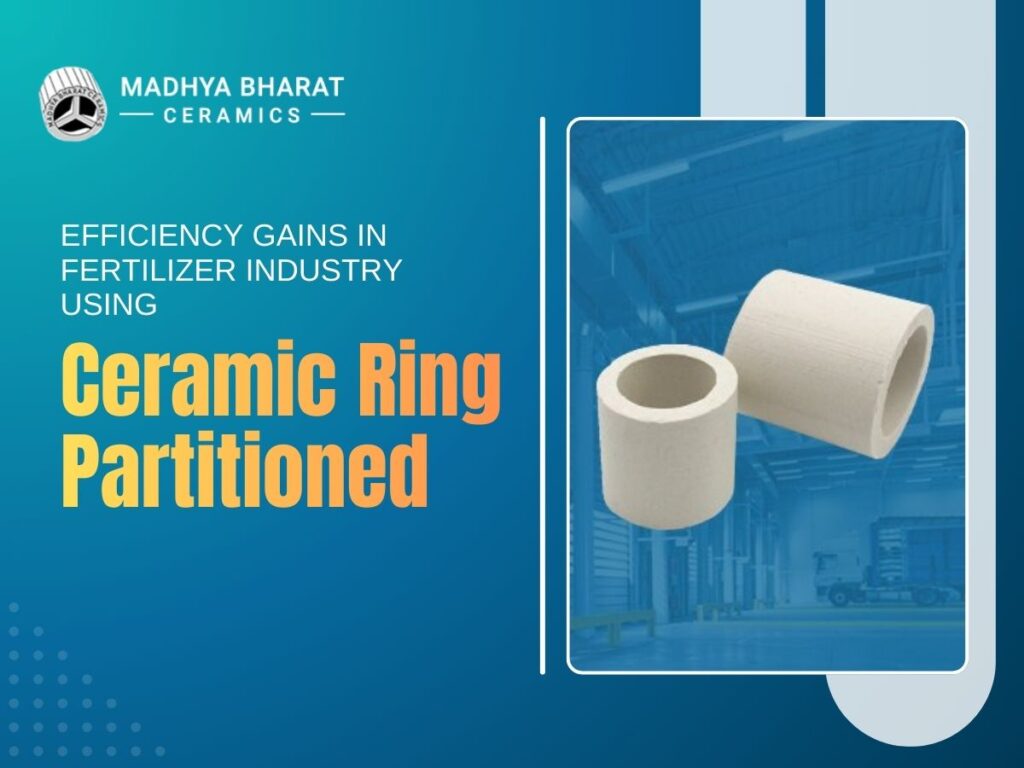
Fertilizer plants depend on efficient chemical processing systems to maintain stable production. Many processes take place inside large industrial towers where gas and liquid must interact properly. If the tower packing material does not work efficiently, the chemical reaction inside the tower becomes slower and energy consumption increases.
This is why the Ceramic ring partitioned in Mandsaur is widely used in fertilizer plant towers. These packing materials are designed with partitions inside the ring structure, which improves gas flow and liquid distribution. Because of this design, they increase reaction efficiency and help maintain stable tower performance.
In many fertilizer production systems, Ceramic Ring Partitioned products work as advanced industrial tower packing media. Their strong ceramic structure helps them resist heat and chemical corrosion.
How Ceramic Ring Partitioned Improves Fertilizer Plant Tower Efficiency
Fertilizer production involves several processes where gases and liquids interact inside tall industrial towers. Efficient tower packing helps these reactions occur faster and more consistently.
The design of Ceramic Ring Partitioned includes internal partitions that improve the distribution of gas and liquid inside the tower. This helps increase contact between the phases and improves reaction efficiency.
Important performance benefits include:
- Improved gas and liquid interaction
- Better liquid spreading across tower packing
- Higher surface area for chemical reactions
- Reduced pressure drop in tower systems
- Improved stability during long operations
Because of these advantages, ceramic rings are widely used as high efficiency mass transfer packing in fertilizer industry towers.
These materials also function as chemical processing tower components that support continuous industrial operations.
Role of Ceramic ring partitioned in India in Fertilizer Production Systems
Many fertilizer plants depend on high quality packing materials to ensure stable chemical processes. This is why Ceramic rings partitioned in India are widely used in industrial towers.
These ceramic packing materials are designed to operate in environments where high temperatures and corrosive gases are present.
Important advantages include:
- Strong resistance to chemical corrosion
- Ability to withstand high temperature environments
- Long operational life inside industrial towers
- Stable performance during continuous production
- Reduced maintenance requirements
Because of these features, ceramic packing works effectively as corrosion resistant ceramic packing in fertilizer production systems.
Their durability also makes them reliable high temperature resistant tower packing used in demanding chemical processes.
Importance of a Reliable ceramic ring partitioned Manufacturer
The performance of tower packing materials depends greatly on manufacturing quality. A reliable ceramic ring partitioned Manufacturer ensures that the ceramic rings are produced with accurate design and strong structure.
Manufacturers use advanced ceramic production methods to create partitioned rings that maintain stable performance inside industrial towers.
Important manufacturing factors include:
- High purity ceramic raw materials
- Accurate partition design for improved mass transfer
- Strong mechanical durability
- Uniform ring dimensions for stable tower packing
- Quality control during production
Fertilizer plants often look for a ceramic ring partitioned manufacturer for fertilizer plant applications because reliable manufacturing improves overall process efficiency.
High quality products help towers operate as industrial tower packing media for many years without performance loss.
Why Fertilizer Plants Depend on a ceramic ring partitioned Supplier
Industrial plants require regular supply of packing materials for installation and maintenance. This makes the role of a ceramic ring partitioned Supplier very important.
Suppliers provide different sizes and quantities of ceramic packing materials based on tower design and process requirements.
Their support helps fertilizer plants maintain uninterrupted production.
Key responsibilities of suppliers include:
- Supplying ceramic rings for new tower installations
- Providing replacement packing materials for maintenance
- Offering different ring sizes for various tower systems
- Supporting technical guidance for installation
- Ensuring consistent availability of products
Industries often search for the best ceramic ring partitioned supplier for fertilizer industry towers to ensure reliable supply and long term operational stability.
Global Industrial Demand for ceramic ring partitioned exporter
The fertilizer industry operates in many countries, and industrial plants often import specialized packing materials. Because of this, the role of a ceramic ring partitioned exporter has become increasingly important.
Exporters help deliver ceramic packing materials to international fertilizer plants.
Their work supports global industrial supply chains.
Key roles include:
- Supplying tower packing materials to international markets
- Ensuring safe packaging and transportation
- Supporting global fertilizer plant construction projects
- Meeting international industrial standards
- Delivering products for large scale industrial systems
Through exporters, ceramic rings partitioned for fertilizer plants became available to industries around the world.
These materials support efficient high efficiency ceramic ring partitioned packing for chemical processing.
Benefits of Ceramic Ring Partitioned for Fertilizer Plants
Efficient tower packing directly affects the performance of fertilizer plant operations. Ceramic Ring Partitioned products provide several benefits that improve production efficiency.
These packing materials increase the contact surface between gas and liquid phases. This improves chemical reaction speed and helps plants maintain consistent product quality.
Important benefits include:
- Improved mass transfer efficiency
- Reduced energy consumption in tower operations
- Better fluid distribution inside process towers
- High durability in chemical environments
- Long service life with minimal maintenance
These advantages explain the efficiency benefits of ceramic rings partitioned in fertilizer plants.
Because of their strong ceramic structure, these materials also function as corrosion resistant ceramic packing.
Industrial Applications of Ceramic Ring Partitioned
Fertilizer plants include several processing units where tower packing materials are essential. Ceramic Ring Partitioned products are widely used in these systems because they support stable chemical reactions.
Common industrial applications include:
- Ammonia absorption towers
- Urea production towers
- Gas purification systems
- Chemical distillation columns
- Industrial reaction towers
In these systems, ceramic rings function as industrial tower packing media that improves gas and liquid interaction.
Their structure allows them to operate effectively as high temperature resistant tower packing in fertilizer plant operations.
Because of these features, many fertilizer plants rely on ceramic ring partitioned packing for fertilizer industry towers.
FAQ’s About Ceramic ring partitioned
1. What is tower packing in fertilizer plants?
Tower packing is a material placed inside industrial towers to improve gas and liquid contact during chemical reactions.
2. Why is ceramic packing used in chemical towers?
Ceramic packing provides strong resistance to heat and chemical corrosion.
3. What is mass transfer packing media?
Mass transfer packing media improves the contact between gas and liquid phases in industrial towers.
4. How does ceramic ring partitioning improve efficiency?
The partitioned structure increases surface area and improves liquid distribution.
5. Are ceramic packing materials durable?
Yes. Ceramic packing materials are known for their long service life.
6. What industries use ceramic tower packing?
Chemical, fertilizer, petrochemical, and environmental industries use ceramic packing.
7. How long do ceramic packing materials last?
High quality ceramic packing materials can last many years under industrial conditions.
8. Can ceramic packing reduce pressure drop?
Yes. Properly designed ceramic packing allows smooth gas flow inside towers.
Conclusion
The ceramic ring partitioned in Mandsaur has become an important component in fertilizer industry tower systems. These ceramic packing materials improve gas and liquid interaction inside chemical process towers, which increases reaction efficiency and production stability.
Their partitioned design provides larger surface area and better fluid distribution. Because of this, fertilizer plants can achieve improved mass transfer performance while reducing energy consumption.
Another important advantage is durability. Ceramic materials provide strong resistance to heat and chemical corrosion. This allows them to operate for many years inside industrial towers without losing performance.
For these reasons, industries continue to rely on ceramic rings partitioned for fertilizer plants to improve tower efficiency and maintain reliable fertilizer production processes.