A major petrochemical refinery in Maharashtra struggled with frequent column packing failures due to severe corrosive conditions in their sulfuric acid alkylation unit. Traditional metal packings corroded within 18 months, causing efficiency losses, unplanned shutdowns, and annual replacement costs exceeding $200,000. In 2023, the facility installed MBC’s ceramic saddles for chemical and petrochemical plants, specifically designed for extreme acid environments. After 24 months of continuous operation, the ceramic saddle packing shows zero degradation, maintains 98% of original mass transfer efficiency, delivers consistent pressure drop performance, and has eliminated all corrosion-related downtime. The refinery projects a 7-year service life with total cost savings exceeding $850,000 compared to previous metallic packing solutions.
Process columns form the heart of separation operations in chemical plants, refineries, and manufacturing facilities worldwide. The packing material selected for these columns directly impacts separation efficiency, energy consumption, operating costs, and system reliability. Ceramic saddles packing has emerged as the preferred solution for demanding applications requiring exceptional chemical resistance, thermal stability, and long-term performance consistency.
MBC, a leading ceramic saddles manufacturer in India, produces advanced industrial ceramic saddles engineered specifically for high-performance process columns. Our precision-manufactured packing delivers superior mass transfer efficiency, minimal pressure drop, and exceptional durability in the most challenging operating environments.
Understanding Ceramic Saddle Packing Design
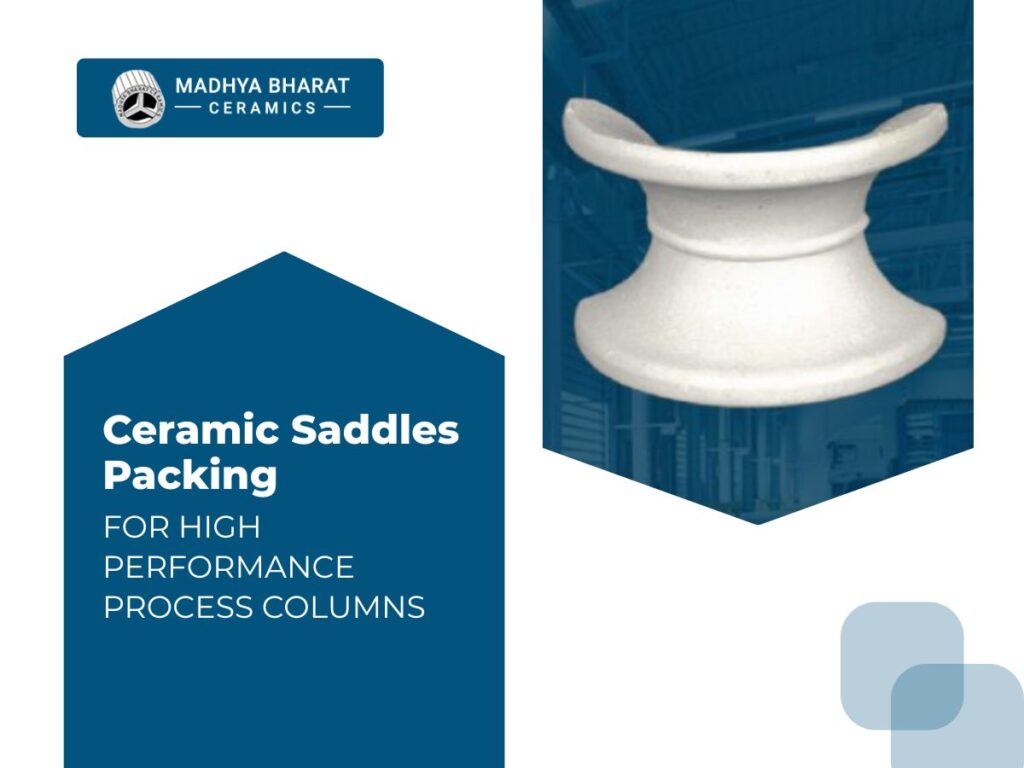
Ceramic saddle packing features a distinctive arch-shaped design that provides optimal liquid distribution, gas-liquid contact, and flow characteristics within process columns. This geometry has been refined through decades of industrial application and computational fluid dynamics analysis.
The saddle shape creates multiple surfaces for liquid film formation and vapor-liquid contact while maintaining high void fraction for minimal pressure drop. This balance between surface area and void space is critical for achieving high separation efficiency without excessive energy consumption.
Key design characteristics include:
- Arch-shaped geometry optimizing liquid distribution
- Multiple contact surfaces maximizing mass transfer area
- Open structure providing 65-75% void fraction
- Smooth surfaces promoting uniform liquid flow
- Precise dimensions ensuring consistent packing density
- Rounded edges preventing breakage during installation
The ceramic saddles supplier MBC employs advanced manufacturing techniques ensuring dimensional consistency and surface quality across every production batch. This precision manufacturing directly translates to predictable column performance and reliable operation.
Superior Material Properties for Demanding Applications
Chemical resistant ceramic saddles manufactured by MBC exhibit outstanding properties making them ideal for aggressive chemical environments, high temperatures, and long-term continuous operation where conventional materials fail.
1. Material composition options:
MBC produces tower packing ceramics from high-purity alumina and industrial porcelain, each offering distinct advantages for specific applications. Alumina saddles provide maximum chemical resistance and temperature capability, while porcelain saddles offer excellent performance at more economical pricing for less extreme conditions.
2. Chemical resistance capabilities:
Chemical resistant ceramic saddles for towers demonstrate exceptional inertness across the complete pH spectrum from strong acids to caustic alkalis. They resist attack from organic solvents, oxidizing agents, halogens, and virtually all industrial chemicals at any concentration and temperature.
Unlike metallic packings that corrode, or plastic packings with limited chemical and temperature resistance, ceramic saddles maintain structural integrity and performance indefinitely in corrosive service. This chemical stability eliminates contamination concerns while providing unlimited service life in many applications.
3. Thermal performance:
Industrial ceramic saddles maintain full mechanical strength and dimensional stability at temperatures up to 1,400°C depending on material composition. This thermal capability enables their use in high-temperature distillation, thermal cracking operations, and other processes where temperature limitations eliminate alternative packing materials.
According to technical literature published by the American Institute of Chemical Engineers, ceramic random packings demonstrate superior performance characteristics in mass transfer operations while offering unmatched durability in corrosive and high-temperature service.
Mass Transfer Performance Excellence
The primary function of column packing is facilitating efficient mass transfer between vapor and liquid phases. Ceramic saddles for mass transfer applications deliver exceptional performance through optimized geometry, surface characteristics, and fluid dynamics.
Performance parameters:
- Specific surface area: 200-500 m²/m³ depending on size
- Void fraction: 65-75% minimizing pressure drop
- Mass transfer coefficient: 40-60% higher than basic random packings
- Pressure drop: 30-50% lower than equivalent structured packings
- Liquid holdup: optimized for efficient vapor-liquid contact
- Turndown ratio: excellent performance across wide flow ranges
Ceramic saddles used in distillation columns provide the intimate vapor-liquid contact necessary for efficient separation while maintaining low pressure drop that reduces energy consumption and operational costs. The arch geometry promotes liquid spreading and film formation across the saddle surfaces, maximizing interfacial area for mass transfer.
Computational fluid dynamics studies demonstrate that saddle packing creates turbulent mixing patterns enhancing mass transfer rates while the open structure allows vapor flow with minimal resistance. This combination of high mass transfer efficiency and low pressure drop represents the ideal performance balance for process columns.
Critical Industrial Applications
Mass transfer ceramic saddles serve essential functions across diverse industries where separation efficiency, chemical resistance, and reliability are paramount for process success and profitability.
1. Chemical and Petrochemical Processing
The chemical industry relies extensively on ceramic saddles for chemical and petrochemical plants in separation processes involving corrosive chemicals, high temperatures, and stringent purity requirements.
Applications include:
- Distillation columns separating chemical mixtures
- Absorption towers removing contaminants from gas streams
- Stripping columns recovering solvents and chemicals
- Scrubbing systems for emission control
- Extraction columns for liquid-liquid separations
- Reaction columns for catalytic processes
Ceramic saddle packing in these applications provides contamination-free operation essential for product quality, eliminates corrosion-related failures that cause unplanned shutdowns, and delivers consistent performance throughout extended service periods.
2. Pharmaceutical and Fine Chemical Manufacturing
Pharmaceutical production demands absolute purity and zero contamination from process equipment. Chemical resistant ceramic saddles meet these stringent requirements while withstanding aggressive cleaning chemicals and sterilization procedures.
The ceramic saddles manufacturer MBC supplies pharmaceutical-grade packing with validated cleanliness, documented material composition, and batch traceability meeting regulatory requirements for pharmaceutical applications.
3. Environmental Control and Pollution Abatement
Industrial ceramic packing plays crucial roles in environmental control systems removing pollutants from industrial gas streams before atmospheric release.
Environmental applications:
- Acid gas scrubbers in power plants
- VOC recovery systems in chemical facilities
- Odor control towers in waste treatment
- Chlorine dioxide scrubbers in pulp mills
- Sulfur dioxide absorption in refineries
The chemical resistance and durability of tower packing ceramics ensures reliable long-term performance in these critical environmental protection systems.
4. Petroleum Refining Operations
Refineries operate some of the most demanding separation processes in industry, requiring packing materials that withstand extreme conditions while delivering optimal performance.
Refining applications include:
- Crude distillation atmospheric towers
- Vacuum distillation columns
- Catalytic cracker fractionators
- Alkylation unit columns
- Sulfur recovery plant towers
Ceramic saddles used in distillation columns at refineries provide the combination of acid resistance, temperature capability, and mass transfer efficiency essential for these challenging services.
Advantages Over Alternative Packing Materials
Comparing ceramic saddle packing to metallic, plastic, and other packing options reveals significant performance and economic advantages justifying their selection for critical process columns.
Performance advantages over metal packing:
- Complete corrosion resistance eliminating replacement needs
- No metallic contamination ensuring product purity
- Higher temperature capability expanding application range
- Consistent long-term performance without degradation
- Lower lifecycle costs despite higher initial investment
Benefits compared to plastic packing:
- Temperature capability 5-10 times higher than plastics
- Chemical resistance across complete pH spectrum
- Mechanical strength preventing deformation under load
- No plasticizer leaching or degradation products
- Suitable for food, pharmaceutical, and potable water applications
Advantages versus structured packing:
- Lower initial cost for equivalent performance
- Easier installation without special tooling or expertise
- Better fouling resistance with simpler cleaning
- Excellent turndown capability for variable operations
- Easier partial replacement without complete column repacking
Size Selection and Column Design Considerations
Optimizing column performance requires selecting appropriate ceramic saddle packing sizes based on column diameter, operating conditions, and performance requirements.
Available sizes:
MBC manufactures industrial ceramic saddles in standard sizes including 12mm, 25mm, 38mm, and 50mm nominal dimensions. Smaller sizes provide higher surface area for maximum mass transfer efficiency, while larger sizes offer lower pressure drop for high-capacity applications.
Selection guidelines:
- Small columns (under 300mm diameter): 12-25mm saddles
- Medium columns (300-1000mm diameter): 25-38mm saddles
- Large columns (over 1000mm diameter): 38-50mm saddles
- High-purity applications: smaller sizes for efficiency
- High-throughput applications: larger sizes for capacity
The ceramic saddles supplier MBC provides comprehensive engineering support helping customers select optimal packing sizes and configurations for their specific column designs and operating requirements.
Installation and Operational Best Practices
Proper installation and operation of ceramic saddles for mass transfer applications maximizes performance, minimizes problems, and extends service life.
Installation guidelines:
- Clean column internals thoroughly before packing installation
- Inspect saddles for damage and remove any broken pieces
- Use proper dumping techniques to prevent segregation
- Achieve uniform packing density throughout the bed
- Install support grids with appropriate free area
- Provide effective liquid distribution above packing
Operational recommendations:
Maintain process conditions within design specifications. Monitor pressure drop and performance indicators regularly. Implement periodic inspection schedules. Follow proper startup and shutdown procedures to prevent thermal shock.
The ceramic saddles manufacturer MBC provides detailed installation instructions, startup guidelines, and troubleshooting support ensuring customers achieve optimal column performance from their ceramic packing investment.
Quality Manufacturing and Global Supply
MBC’s position as a premier ceramic saddle packing manufacturer reflects our commitment to quality, consistency, and customer service. Our ISO-certified manufacturing facilities employ advanced processes and rigorous quality control.
Quality assurance measures:
- Raw material testing verifying composition and purity
- Dimensional inspection ensuring specification compliance
- Surface quality evaluation for optimal performance
- Mechanical strength testing confirming durability
- Batch documentation providing complete traceability
- Performance testing validating mass transfer characteristics
As an established ceramic saddles exporter, MBC serves customers worldwide with comprehensive logistics capabilities ensuring timely delivery regardless of location. Our global supply network combines manufacturing excellence with efficient distribution and responsive customer support.
Technical Support and Engineering Services
Beyond manufacturing superior products, MBC provides comprehensive technical support helping customers optimize column performance and solve processing challenges.
Engineering services include:
- Column packing selection and sizing
- Performance prediction and modeling
- Troubleshooting and problem resolution
- Column retrofit and upgrade consulting
- Installation supervision and training
- Performance monitoring and optimization
According to the International Organization for Standardization, customer focus and continuous improvement are essential elements of quality management. MBC’s commitment to these principles ensures every customer receives not just superior tower packing ceramics but also the technical expertise to maximize their investment value.
Economic Value and Lifecycle Cost Analysis
While ceramic saddle packing may have higher initial costs compared to some alternatives, total lifecycle cost analysis consistently demonstrates superior economic value through extended service life, reduced maintenance, and consistent performance.
Cost factors to consider:
- Initial packing purchase price
- Installation labor and equipment costs
- Operating energy consumption from pressure drop
- Maintenance requirements and frequency
- Replacement frequency and associated downtime costs
- Product quality impacts from contamination or efficiency loss
Properly selected and installed chemical resistant ceramic saddles typically provide 5-10 years of maintenance-free service, compared to 1-3 years for metallic packings in corrosive service or 2-5 years for plastic packings. This extended service life, combined with superior performance consistency, delivers compelling economic advantages.
Future Developments in Ceramic Packing Technology
Research and development continues advancing industrial ceramic saddles technology to meet evolving industry requirements and enable next-generation process improvements.
Emerging innovations include:
- Enhanced surface treatments improving wetting characteristics
- Optimized geometries for specific separation applications
- Composite materials combining multiple property advantages
- Advanced manufacturing techniques reducing costs
- Computational modeling for custom design optimization
- Integration with process monitoring and control systems
The National Institute of Standards and Technology recognizes advanced ceramics as enabling materials for industrial competitiveness and environmental sustainability. Ongoing innovation ensures ceramic saddles for mass transfer applications continue delivering superior value for future process challenges.
FAQ’s About Ceramic Saddles
1. What are ceramic saddles used for in process columns?
Ceramic saddles packing provides surfaces for vapor-liquid contact in distillation, absorption, and stripping columns. They facilitate mass transfer between phases while maintaining low pressure drop, enabling efficient separation of chemical mixtures.
2. How long do ceramic saddles last?
Industrial ceramic saddles typically provide 5-10 years of service in most applications, with potentially unlimited life in non-abrasive, non-fouling services. Actual service life depends on operating conditions, chemical environment, and maintenance practices.
3. What size ceramic saddles should I use?
Size selection depends on column diameter and application requirements. Smaller saddles (12-25mm) provide higher efficiency for purity-critical applications. Larger saddles (38-50mm) offer lower pressure drop for high-capacity operations. Consult manufacturers for specific recommendations.
4. Are ceramic saddles better than metal packing?
Chemical resistant ceramic saddles offer superior corrosion resistance, zero contamination, and longer service life compared to metal packings. While initially more expensive, they provide better lifecycle economics in corrosive services and purity-sensitive applications.
5. Can ceramic saddles handle high temperatures?
Yes, tower packing ceramics maintain structural integrity and performance at temperatures up to 1,400°C depending on material composition. This exceptional thermal stability makes them suitable for high-temperature distillation and thermal processing applications.
6. How do ceramic saddles improve mass transfer efficiency?
The arch-shaped geometry creates multiple liquid-vapor contact surfaces while promoting liquid spreading and film formation. This maximizes interfacial area for mass transfer while maintaining high void fraction for low pressure drop and efficient separation.
7. What chemicals can ceramic saddles resist?
Chemical resistant ceramic saddles for towers resist virtually all industrial chemicals including strong acids, caustic alkalis, organic solvents, oxidizing agents, and halogens across the complete pH spectrum at any concentration and elevated temperatures.
8. How are ceramic saddles installed in columns?
Ceramic saddle packing is typically dumped into columns from the top using proper techniques to ensure uniform density. Support grids must be installed below the packing bed, and effective liquid distribution systems above the packing ensure optimal performance.
Conclusion
Ceramic saddle packing represents the optimal solution for high-performance process columns requiring exceptional chemical resistance, thermal stability, and long-term reliability. Their superior mass transfer efficiency, minimal pressure drop, and maintenance-free operation deliver measurable performance improvements and cost savings across diverse industrial applications.
MBC’s position as a leading ceramic saddles manufacturer in India reflects decades of manufacturing excellence, technical innovation, and customer commitment. Our precision-manufactured industrial ceramic saddles combine optimal geometry with superior material properties, ensuring you receive packing engineered for maximum performance in your specific application.