Every year, Indian industrial plants lose millions of rupees because of grinding media that fails under extreme heat or chemical exposure. Equipment breaks down. Production stops. Costs rise.
High alumina ceramic balls in India are solving this problem across hundreds of factories. These balls are made from aluminum oxide (Al2O3), a material known for its outstanding thermal stability of alumina and corrosion resistance in ceramics.
According to the American Ceramic Society, alumina ceramics maintain structural integrity at temperatures exceeding 1600 degrees Celsius. This makes them among the most reliable high temperature industrial materials available today.
Fact: Alumina has a melting point of approximately 2072 degrees Celsius, one of the highest among commercially used ceramic oxides.
Fact: The global ceramic grinding media market was valued at over USD 800 million in 2023 and is expected to grow steadily through 2030, driven largely by demand from India and Southeast Asia.
Case Study
A specialty chemicals manufacturer in Rajasthan was using standard steel grinding balls in their ball mill reactors. The plant processed highly acidic slurries at temperatures between 300 and 500 degrees Celsius.
Within six months, the steel balls corroded heavily. Product contamination rates increased. The plant had to shut down every 90 days for media replacement.
The plant switched to high alumina ceramic balls with 95% Al2O3 content from a supplier in Mandsaur. Results after one year:
- Downtime reduced by 40%
- Product contamination eliminated
- Media replacement cycle extended from 90 days to 14 months
- Overall cost savings of approximately Rs. 18 lakhs per year
This is not an isolated case. Across India, industries are recognizing the performance advantage of ceramic grinding media over metal alternatives.
What Are High Alumina Ceramic Balls?
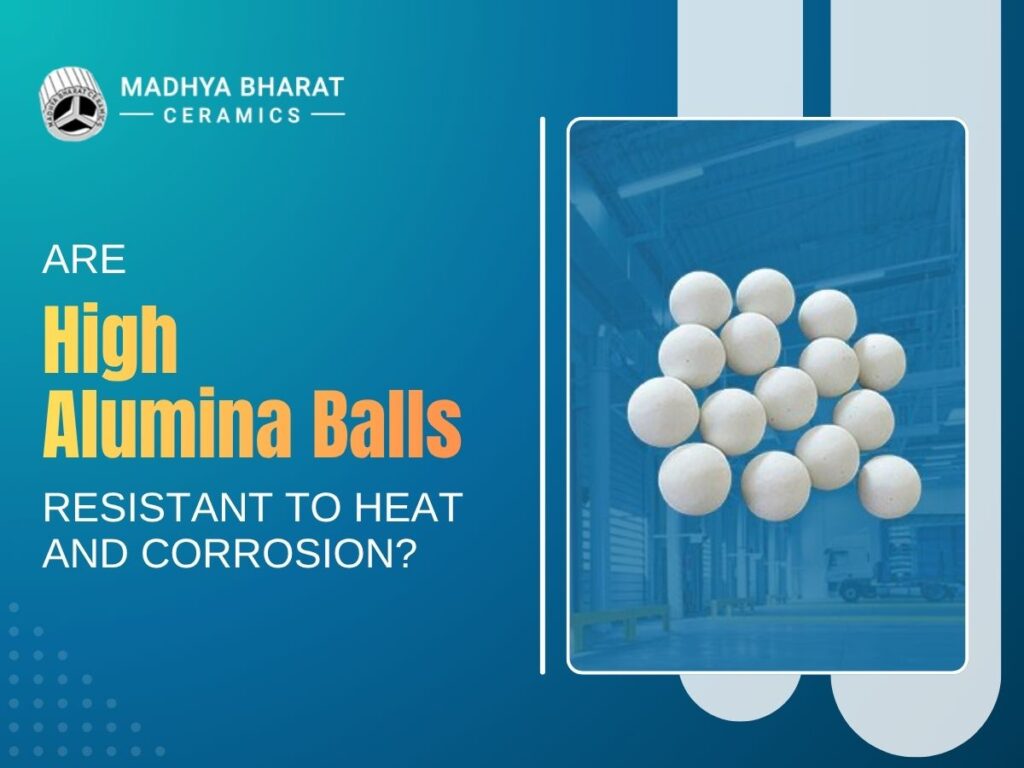
High alumina balls are dense, spherical grinding and filling media produced by pressing and sintering aluminum oxide powder at very high temperatures. The alumina content typically ranges from 75% to 99%.
The higher the alumina percentage, the better the ball performs in heat, chemical, and wear resistance. Most industrial-grade products fall into two main categories:
- Medium Alumina (75% to 85% Al2O3): Suitable for standard grinding and general industrial use.
- High Alumina (90% to 99% Al2O3): Designed for extreme conditions involving high heat, aggressive chemicals, or abrasive materials.
MBC manufactures and supplies high alumina ceramic balls in Mandsaur, producing grades from 92% to 99% Al2O3 to meet specific client requirements.
Are High Alumina Balls Resistant to High Temperatures and Corrosion?
This is the most commonly searched question about this product. The short answer is yes. Here is the detailed explanation.
Thermal Stability: How High Alumina Balls Perform in Extreme Heat Conditions
Thermal stability of alumina comes from the crystalline structure of aluminum oxide. When sintered correctly, the Al2O3 molecules form a dense lattice structure that resists thermal expansion and structural breakdown.
Key heat performance data for high alumina ceramic balls:
| Property | 92% Alumina Ball | 95% Alumina Ball | 99% Alumina Ball |
| Max Operating Temperature | 1500 degrees C | 1650 degrees C | 1750 degrees C |
| Thermal Shock Resistance | Good | Very Good | Excellent |
| Hardness (Mohs Scale) | 8.5 | 9.0 | 9.2 |
| Bulk Density (g/cm3) | 3.60 | 3.68 | 3.85 |
| Water Absorption | Less than 0.02% | Less than 0.01% | Near Zero |
In cement kilns, for example, grinding media operates near continuous heat of 1200 to 1400 degrees Celsius. Standard steel or low-grade ceramic media deforms or cracks. High alumina balls remain dimensionally stable, maintaining grinding efficiency throughout.
Corrosion Resistance: Why High Alumina Ceramic Balls Resist Corrosion in Reactors
Chemical inertness of alumina balls is one of their most important properties. Alumina does not react with most acids, alkalis, or organic solvents. This is why chemical plants, pharmaceutical manufacturers, and food processing units prefer ceramic media over metal alternatives.
Specific corrosive environments where high alumina balls perform reliably:
- Strong acids (sulfuric acid, hydrochloric acid, nitric acid)
- Alkali solutions (sodium hydroxide, potassium hydroxide)
- Oxidizing environments at elevated temperatures
- Salt solutions in marine or coastal industrial settings
- Organic solvents used in pharmaceutical manufacturing
In pH environments ranging from 1 to 13, 95% and 99% alumina balls show virtually zero weight loss or surface degradation after 1000 hours of immersion, as documented in material testing reports by leading ceramic research institutes.
This level of corrosion resistance in ceramics makes them the best choice for industries that cannot afford product contamination or media failure.
Benefits of Using High Alumina Balls in Chemical Industries
Industries working with reactive substances gain multiple advantages by choosing industrial ceramic balls over conventional grinding media.
Operational Benefits:
- No iron contamination in the final product
- Stable performance across wide temperature ranges
- Long service life reduces replacement frequency
- Smooth surface finish reduces wear on mill liners
- Suitable for wet and dry grinding applications
Economic Benefits:
- Lower total cost of ownership compared to steel or low-grade ceramic
- Fewer unplanned shutdowns due to media failure
- Reduced quality rejection rates due to cleaner processing
Environmental Benefits:
- No heavy metal leaching into waste streams
- Alumina is chemically stable and environmentally inert
- Longer lifespan means less industrial waste
Best Heat and Corrosion Resistant Ceramic Balls for Industrial Use
Choosing the right grade depends on your specific application. Here is a practical guide:
92% Alumina: Best for general grinding in ceramic, tile, and building materials industries. Offers good wear resistance at a competitive price.
95% Alumina: Ideal for chemical, pharmaceutical, and paint industries where both heat and mild chemical exposure are concerns.
99% Alumina: Recommended for the most demanding environments: high-temperature furnace lining, aggressive acid reactors, and precision grinding where contamination must be zero.
High Alumina Ceramic Balls for Extreme Industrial Conditions require not just the right alumina percentage but also correct sizing, surface finish, and density to match your specific mill or reactor design.
Why Choose MBC as Your High Alumina Ceramic Balls Manufacturer
MBC is among the most trusted High Alumina Ceramic Balls exporters in Mandsaur. With manufacturing facilities in Mandsaur, Madhya Pradesh, MBC serves clients across India and in international markets.
Why clients across India choose MBC:
- Consistent alumina purity verified by third-party lab testing
- Custom sizes available from 1 mm to 90 mm diameter
- ISO-certified production process with strict quality control
- Fast dispatch and reliable logistics across India and globally
- Technical support team to help you select the right grade
As a leading high alumina ceramic balls manufacturer in India, MBC maintains high production standards and transparent pricing for bulk and project-based orders.
Case Study
A fertilizer plant in Gujarat used conventional ceramic balls in their grinding circuit. The balls were rated at 75% alumina. The plant’s slurry contained phosphoric acid at concentrations reaching 40%.
After 4 months, the balls showed surface pitting and weight loss of 12%. This contaminated batches and increased per-tonne grinding cost.
The plant upgraded to high alumina ceramic balls with 99% Al2O3 content sourced from high alumina ceramic balls exporters in Mandsaur. After 12 months of operation:
- Ball weight loss dropped to under 0.5%
- No product contamination was detected
- Media service life extended from 4 months to 13 months
- The plant reduced annual media procurement costs by Rs. 24 lakhs
This real-world result demonstrates the wear-resistant ceramic media advantage in harsh chemical environments. The investment in higher-grade alumina balls returned measurable value within the first year.
FAQ’s About High alumina ceramic balls
1. What are high alumina ceramic balls made of?
They are made of sintered aluminum oxide (Al2O3) powder, processed at very high temperatures for density and hardness.
2. What alumina percentage is best for chemical industries?
For chemical industries with acidic or alkaline conditions, 95% to 99% alumina grade is recommended for maximum corrosion resistance.
3. Are high alumina balls safe for food and pharmaceutical grinding?
Yes. Their chemical inertness means no contamination, making them safe for food, cosmetic, and pharmaceutical grinding applications.
4. How do I select the right size of high alumina ceramic balls?
Ball size depends on the feed material size and mill diameter. A technical supplier like MBC can help you calculate the right size for your application.
5. What is the maximum temperature high alumina ceramic balls can handle?
Depending on grade, they handle temperatures from 1500 degrees Celsius (92% Al2O3) up to 1750 degrees Celsius (99% Al2O3).
6. Where are high alumina ceramic balls manufactured in India?
Mandsaur in Madhya Pradesh is a leading hub for high alumina ceramic ball manufacturing. MBC is one of the top manufacturers and exporters in this region.
7. Can high alumina ceramic balls replace steel grinding media completely?
In most industrial applications involving heat, chemicals, or contamination sensitivity, yes. High alumina balls are a superior long-term replacement for steel grinding media.
8. What industries use high alumina ceramic balls the most?
Cement, chemicals, pharmaceuticals, ceramics, paints, fertilizers, mining, and food processing industries are the top users of high alumina ceramic balls in India.
Conclusion
High alumina ceramic balls in India are not just a product choice. They are a strategic industrial decision. Their proven resistance to extreme heat, corrosive chemicals, and mechanical wear makes them indispensable in modern manufacturing.
From a small dye factory in Gujarat to a large cement plant in Rajasthan, industries across India are switching to high alumina balls for better performance, lower costs, and cleaner production.
MBC, based in Mandsaur, brings together manufacturing expertise, strict quality control, and technical knowledge to supply the right grade of ceramic grinding media for your application. Whether you need 92%, 95%, or 99% alumina, MBC has the product and the support to match your industrial needs.